

Sounds of Time
(Short story)
Publish Date: Thu 26th Feb 2026
Guest Author: Ehis Mokwenye
Jideofor lay awake beneath the new thatch roof, staring into the dark as though it might stare back. Sleep hovered close but refused to take him. Each time his body drifted toward rest, something tightened inside him, drawing him back to waking. It was not discomfort that kept him alert, nor the unfamiliar smell of the hut, but fear—quiet, insistent fear—of what waited for him when he closed his eyes.
For several nights now, the same dream had returned.
It did not behave like other dreams. It did not dissolve with morning or blur at the edges when he tried to recall it. It remained intact, vivid, pressing itself upon his thoughts with the weight of something lived rather than imagined. In the dream, he found himself moving through dense undergrowth, branches tearing at his skin as though trying to hold him back. The forest was thick and lightless, the kind the elders warned children not to enter; the forbidden forest, where paths vanished and sounds were swallowed whole.
He was not alone.
Others moved with him, though he could not see their faces. He knew only that they were bound together. Rough fibres cut into his wrists, biting deeper with every step, and when he looked down, he saw the rope—coarse, unforgiving—looped tightly around his arms. It pulled him forward whether he wished to move or not. No one spoke. No one cried out. The silence was complete, heavy enough to press against his chest.
Ahead, water waited.
A stream ran low and slow across their path, dark and shallow, its surface unbroken by sound. As they were driven into it, the water closed around his ankles, cool and steady, carrying with it a dread that had nothing to do with depth. The ropes tightened. The forest leaned inward. And somewhere, always just beyond sight, there came the sense of a presence; watching, patient.
Then the dream would break.
Jideofor would wake suddenly, his body slick with sweat, his breath trapped high in his chest. The hut would return around him; the low walls, the unfamiliar angles of his new space. But the feeling lingered, stubborn and unresolved.
He had been blessed, his mother once told him, with a peculiar gift—the ability to move consciously between worlds in his sleep. From as far back as he could remember, his dreams had never been empty or fleeting. They carried weight. Texture. Continuity.
She said it meant his chi was unusual. That he carried the soul of a dịbịa.
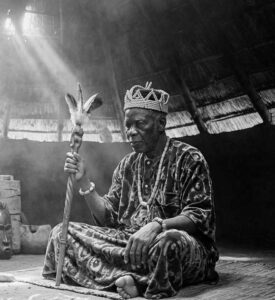
There were others, she explained, who shared this closeness to the unseen—the ọ̀gbànje, the àmọ́sù, and the dịbịa alike. All possessed the same rare awareness: the knowledge that the soul did not rest when the body slept. Each night, one’s chi loosened itself and travelled beyond the flesh, crossing into the realm of spirits. What most people remembered as dreams were only fragments of those journeys, blurred by waking. But the journeys themselves were real. As real as the earth beneath their feet.
“The spirit world is not separate from this one,” she had told him quietly. “What happens there finds its way here.”
She said his ability to remember his dreams—clearly, persistently—was proof. Memory was not accidental. It was a sign of purpose. To remember was to be aware of one’s soul, and to be aware was to carry responsibility.
He reached instinctively for the cord at his neck.
The small piece of jewellery rested against his chest, warm from his skin. His fingers closed around it, rubbing its worn surface slowly, as though the motion itself might steady his breath. It had been given to him by his father.
He remembered the day clearly.
They had sat together in the shade at the edge of the compound, his father turning the object over in his hands before placing it around Jideofor’s neck. Before fastening it, he had told him a story.
“Our people did not spring from this soil alone,” his father had said. “Long ago, we crossed the great Ọ́shìmílí and laid the foundations of Illah.”
He spoke of Eri, the ancestor whose skin was said to carry the hue of the morning sun. Some claimed he had come forth from Éluigwe, bearing strange implements, rare beasts, and sacred knowledge. Among those who travelled with him were the first of the Ndị Igbo ọbara ọcha; the red people, whose lighter skin set them apart. When they mingled with those they found upon this land, a new lineage emerged, and even now their children bore the mark of that union.
“But blood was not all we inherited,” his father had said. “They carried gifts.”
The osẹ̀-ọ́jị of the oracles. The herbs of covenant. The means by which one entered communion with the Gods.
Now, lying alone beneath the new thatch roof, Jideofor pressed the object gently against his chest. Whatever the dreams meant, he was not unmoored. He was held—by blood, by memory, by covenant.
Turning onto his side, now facing the entrance of the hut, he was momentarily mesmerised by the soft glow of the moon. It spilled gently through the doorway, illuminating the darkness just enough to reveal the familiar outlines of his new space. The night was clear, still, listening.
Encapsulated by his thoughts, he did not notice when wakefulness loosened its grip. Sleep claimed him gently, without warning. It was only interrupted once more by the sound of a cock’s crow by his doorway.
When he woke, he felt bedazzled. There was no recollection of sleep or dreams—no lingering images, no sense of passage. One moment he had been suspended in contemplation and unease, and the next, he could hear the distinctive “Koo-koo-ru-koo!” of the loudest chicken in the family compound.
The dawn came quietly, and the day began to move.
Sunlight streamed through the single window of his hut, its pale rays inching slowly across the packed earthen floor. The light crept up his wooden bed and struck his face. He stirred, lifting a hand to shield his eyes.
For a moment, there was nothing.
No dream. No image. No residue of passage.
That unsettled him more than fear ever had.
Why can’t I remember last night? The thought pressed itself upon him. Was something changing within him—his gift dulling, slipping away as he grew older?
He rose and crossed the hut to the corner where his father had arranged the objects of lineage. A spear hung there, its shaft darkened with age. Beneath it rested a carved figure of Ìkéńgà and a terracotta head of the family matriarch. These were not decorations. They were guardians.
He washed his face, hands, and feet from a calabash of water, then squatted before the shrine. He prayed quietly; for strength, for clarity, for a day that would pass without dishonour. Rising, he reached for his chewing stick, split its end against a stone, and placed it between his teeth.
Routine returned him to himself.
The compound soon settled into the tranquillity of a waning harmattan morning. Goats bleated softly. Hens clucked as they wandered across the earth. Beyond these sounds, the world seemed content to rest.
Jideofor reached for a broom.
Being barred from farm work because of his asthma had left him with a quiet insecurity. Labour was proof in Illah. Until he could offer it fully, he would make himself useful where he could. He sprinkled water across the ground to keep the dust low, then swept methodically, mindful of his breath.
By the time his siblings, Ifeoma and Chijioke emerged, he was harvesting ụ́gụ̀ leaves in their mother’s garden. He relayed her instructions for the day and delivered the far more welcome news that all chores had already been completed. The children danced around him in delight at the promise of extra ọ́gbọ́nọ̀ soup later that evening before racing off to eat the meal their mother had prepared.
Jideofor followed them, smiling.
For the first time that morning, his chest felt light. He had risen early, taken responsibility, and seen it through. However briefly, it reassured him that he might yet grow into the expectations Illah would one day place upon him.
By the afternoon, the air grew heavy with heat, humid and unbearably sticky, as though the land itself had begun to sweat. The harmattan’s earlier coolness had fully withdrawn, leaving behind a thickness that clung to skin and breath alike. Across Illah, people retreated indoors or gathered beneath trees and overhangs, waiting for the sun to soften its hold.
Jideofor and his siblings had returned to their parents’ chambers, seeking refuge from the heat. There, in the dimmer air of the room, they laid out the ụkọ board between them. Smooth pebbles and seeds were distributed across the twelve shallow recesses carved into the wood, their surfaces polished by years of use.
Chijioke, still buoyant from the morning’s freedom, joined eagerly at first. But it did not take long for frustration to settle in. The older children anticipated his moves too easily, capturing his pebbles with practiced ease. After a few losses, his enthusiasm waned.
“I’m done,” he announced, pushing himself away from the board.
He wandered out into the compound, where he amused himself feeding a chicken he had grown attached to. Even that soon lost its appeal in the oppressive heat. Before long, he returned to the room, climbed onto his parents’ bed, and fell into a deep, exhausted sleep.

Ifeoma and Jideofor remained.
They had just begun their thirteenth game, and Ifeoma leaned forward with renewed determination. She had counted carefully. If she won this round, she would narrow the gap between his seven victories and her own.
“Just watch, Jideofor,” she said, a sly smile playing on her lips. “This time, you’ll beg me to end the game.”
He laughed, shaking his head. “You always say that.”
Yet as he reached for the next pebble, a faint unease stirred within him — uninvited, unexplained. It passed quickly, dismissed as fatigue or lingering heat. Daylight, after all, had a way of dissolving such things.
“Kpoooooowwwwwwww!”
The sound tore through the Illah valley like fire ripping through dry grass.
For a split second, it felt as though the earth itself had cracked open. Then came the chaos; startled birds shrieking as they burst from the treetops, wings beating wildly as they fled. From farther away rose the panicked cries of animals, and faintly, the distant shouts of people near Onya stream.
The echo rolled across the valley, an explosive roar that shattered the afternoon’s languid calm. Inside the room, the siblings froze. The pebbles lay forgotten between them.
They looked at one another, confusion etched across their faces.
“Perhaps a tree fell?” Ifeoma ventured.
“That didn’t sound like a tree,” Jideofor replied slowly.
“Thunder, then?” she suggested, grasping for familiarity.
“What kind of thunder sounds like that?” he said. He rose slightly and peered toward the doorway. “There are no clouds. The sky is clearer than Onya stream in the dry season.”
He hesitated, then added, more to reassure himself than her, “Whatever it was, we may never hear it again.”
“Kpoooooowwwwwwww!”
The second blast struck harder than the first — louder, closer. The sound slammed into the air with such force that Jideofor felt it in his chest. Once again, birds and animals erupted into frantic motion, crashing through vegetation as though fleeing an unseen predator.
In her sudden turn, Ifeoma’s arm clipped the edge of the board. The ụkọ tray tipped, sending pebbles skittering across the clay floor. The small, sharp clatter sounded fragile beneath the weight of the blast.
Jideofor was fourteen. Their parents were away.
Something deep within him shifted.
Instinct rose where certainty failed. Whatever had made that sound did not belong to their world, and in its presence, he felt an urgent need to protect his siblings, his home — if only by understanding what threatened it.
Ifeoma searched his face, her eyes wide.
“Jideofor… should we go and see?” she asked, her voice low, urgent.
He paused. Doubt and curiosity wrestled within him. Then he nodded.
“Yes,” he said. “Let’s go.”
They stepped out into the yard, where the animals still stirred uneasily, as though the sound had unsettled something deep within them. Chickens paced in restless circles, their heads jerking sharply at the smallest movement. Goats tugged against their tethers, bleating low and insistent. Even the dogs lingered close to the ground, alert, watching the valley with ears pricked.
Beyond the compound, the land opened into an uneasy stillness.
The narrow path leading toward Onya stream lay ahead, familiar yet subtly altered, as though it had shifted while their backs were turned. Jideofor hesitated only briefly before stepping forward. Ifeoma fell into stride beside him, her hand brushing his arm as they walked.
“Maybe it was an iroko tree that fell near the stream,” she said again, her voice softer now.
“Iroko trees don’t fall twice in the same place,” Jideofor replied. “And not one after the other.”
The air grew heavier as they moved away from the compound. The heat remained, but it now carried a scent that unsettled them—partly like burning wood from a cooking fire, yet threaded with something sharper, metallic. Each breath irritated the back of Jideofor’s throat, leaving a faint itch that made him swallow repeatedly. The smell clung stubbornly, refusing to disperse.
Along the path, signs of disturbance emerged. In places, the tall grass lay flattened, pressed into the earth as though trampled by hurried feet or large bodies moving without regard for the beaten trails. Twigs lay snapped at odd angles. Leaves were torn and scattered. Nothing sat where it should have.
The birds were gone.
No calls rose from the treetops. No wings cut through the air. Even the lizards that usually darted across the path were absent. The silence pressed down on them, thick and unnatural, as though the world were holding its breath.
Jideofor felt it first in his chest; a tightening that had nothing to do with asthma. His hand drifted instinctively to the cord at his neck. He rubbed the small piece of jewellery once, then forced his hand away.
“Do you hear anything?” Ifeoma asked.
He strained his ears. Nothing answered him. Not a frog. Not an insect. Not the low rustle of life that usually threaded through the forest.
After a while, doubt crept in.
“I don’t know, Ifeoma,” he said quietly. “If we were going to find something, we would have by now.”
“So… should we go back?” she asked, relief flickering briefly across her face.
She turned to retrace their steps.
Her ankle brushed against something that did not yield like grass.
She froze.
Slowly, she looked down.
Half-hidden beneath the tall vegetation lay a girl’s hand—fingers slack, lifeless, reaching toward nothing. The body lay face-down in the grass, a wrapper darkened and soaked through with blood from a wound in her back. The earth beneath her was stained.
Ifeoma clutched Jideofor with a strength he did not know she possessed. She tried to speak, but no sound came.
Jideofor stared, his mind resisting what his eyes confirmed. The forest seemed to draw closer, its silence deepening.
Then instinct took over.
“Run,” he whispered.
They turned and fled.
The path back to the compound stretched before them, familiar yet suddenly endless. Their feet struck the earth in frantic rhythm as branches clawed at their skin and tall grass lashed against their legs. Ifeoma struggled to keep pace, her breath coming in sharp, uneven bursts. Jideofor surged ahead, driven by a single thought; to get her home.
The distance warped. Panic narrowed his world to pounding heartbeats and burning lungs.
Then Ifeoma sensed it.
Movement at the sides of her vision first, then by Jideofor’s own up ahead—too deliberate to be imagined. Figures cut through the brush on both sides of the path, closing in.
She caught a glimpse of red cloth flashing between the leaves.
“Jideofor!” she cried. “Someone is chasing us!”
Her foot struck something hidden beneath the grass. She stumbled and fell hard onto the dusty earth, the breath driven violently from her chest.
Before she could rise, rough hands seized her.
A man burst from the bushes like a leopard and pinned her down with brutal ease. In swift, practiced motions, he bound her arms with a short rope, pulling the knots tight as he laughed—a sharp, satisfied sound.
“This one thinks she can run, ehn?” he sneered.
Jideofor turned at the sound of her cry.
Another man erupted from the undergrowth and slammed into him, driving his lanky frame to the ground. The impact knocked the wind from his chest. A grimy, calloused palm clamped over his mouth and nose, cutting off his breath. He thrashed beneath the weight, panic surging as darkness pressed in at the edges of his vision.
When the hand shifted to pin his shoulder, Jideofor gasped and cried out—half in shock, half in desperate hope that someone, anyone, might hear.
No one did.
He swung blindly, his fist clipping the top of the man’s head. The blow dislodged a red-and-white head-dress, which tumbled to the ground. The man barely flinched. Slender though he was, his strength was deceptive, hardened by years of labour. Jideofor writhed, but the grip held firm.
Now bound, the siblings were dragged mercilessly through the brush. Their skin scraped against roots and stones, though pain barely registered amid the terror. Only when they were hauled upright again did the sting of cuts and abrasions announce themselves.
Branches snapped from nearby shrubs were used as whips, striking their backs and legs, driving them forward along an unfamiliar, uneven path.
Ahead, the forest opened.
At the edge of the stream, other children lay bound. Some were gagged, whimpering softly, eyes swollen with terror. Others were tethered together in crooked lines, ankles tied crudely to one another. Around them, their captors moved with grim efficiency, hands quick and certain as they tightened knots and barked orders.
One man carried a strange device. It was wooden at the base, but crowned with a length of metal that caught the afternoon light. Jideofor had never seen anything like it, yet the way it was handled told him all he needed to know.
Rough hands shoved him and Ifeoma down among the captives. Rope bit into his wrists, the fibres grinding into already raw skin.
Then someone broke free.
A girl bolted up the path, desperation lending speed to her limbs. For a heartbeat, hope flared.
“Kpoooooowwwwwwww!”
The crack split the air at close range, violent enough to rattle Jideofor’s chest and leave his ears ringing. The girl jerked forward and collapsed, her body crumpling lifelessly to the ground. A gaping wound smoked faintly in her back.
The captives froze.
This was no arrow. No spear. This was death that leapt invisibly, faster than the eye could follow.
Terror locked Jideofor’s limbs. His mouth went dry, his chest tight beneath an unbearable weight. Beside him, Ifeoma’s breath hitched, her wide eyes fixed on the gleaming metal.
He wanted to shield her. To turn her away.
Instead, rough hands seized them again, yanking them into line with the others.
They were driven into the shallow stream. The rains had not fallen for three moons, and the water barely reached their ankles as they stumbled forward. The coolness sent a chill through Jideofor’s body that had nothing to do with temperature.
A sharp rock grazed his foot.
And then it came—not fear, but recognition.
He had been here before.
The ropes biting into his wrists. The suffocating silence of children too terrified to cry. The slow pull of water around his ankles. Every detail rose with dreadful clarity, unfolding not as something new, but as something remembered.
This was the dream.
He had seen it in fragments during restless nights, always waking before the end. He had never understood what the dreams were trying to tell him.
Now he did.
They had not been shadows cast by sleep. They had been warnings.
Rough hands shoved him forward again. The line lurched, water rippling around their ankles as they were driven onward. Ifeoma stumbled beside him, her breath uneven, her eyes fixed straight ahead.
Jideofor wanted to speak to her. To promise something—anything.
But there were no words left that could hold.
Step by step, the dream unfolded.
And this time, there would be no waking from it.
Ehis Mokwenye
Author | Cultural Storyteller
Instagram: @farastein_eiheez